ASKINTENSIVISTASKINTENSIVISTASKINTENSIVISTASKINTENSIVIST
  • About
    • About Us
    • About Dr. Anand Bhabhor
    • History of ICU
    • Critical Care in Two Tier Cities in India
  • Procedures In ICU
    • Ascites Fluid Tapping
    • Arterial Blood Gas
    • Arterial Line Insertion
    • Bone Marrow Biopsy
    • Bronchoscopy
    • Central Line Insertion
    • Dialysis Port Insertion
    • EEG EMG NCS
    • Foley Catheter Insertion
    • Intubation
    • Lumbar Puncture
    • Percutaneous Endoscopic Gastrostomy
    • Pericardiocentesis
    • Peripheral Catheter Insertion
    • Pleural Fluid Tapping
    • Pulmonary Arterial Catheter Insertion (PA Cath)
    • Ryles Tube Insertion
  • Events In ICU
    • Bedsores (Pressure Ulcer)
    • Collapsed Lung
    • Complications of Immobilization
    • Critical Illness Neuro-Myopathy
    • Stroke
    • Venous Thromboembolism (VTE)
  • Common Care In ICU
    • Physiotherapy
  • Investigations In ICU
    • Digital Subtraction Angiography (DSA)
    • Radiology
  • FAQs

Complications of Immobilization

By Dr. Reena Javkar | Events In ICU | 0 comment | 23 May, 2019 | 4

COMPLICATIONS OF IMMOBILIZATION

Prolonged bed rest and immobilization leads to complications which are much easier to prevent than to treat.

Various causes of immobilization can be as follows:

Enforced bed rest due to illness

Paralysis

Immobilization of body parts with braces, casts or corsets

Joint stiffness and pain with protective limitations of motion

Mental disorders

Loss of sensation / discomfort which prevents frequent change of position

Chronically ill, disabled and geriatric patients are at increased risk.
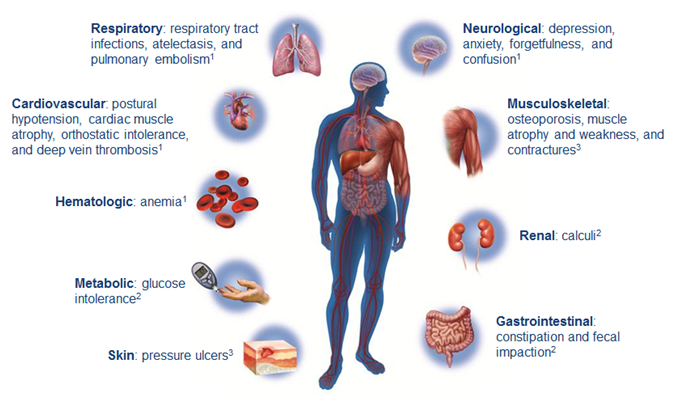
Image Source: https://www.hill-rom.com/international/Clinical-Solutions/clinical-programs/progressive-mobility-program/Complications-of-Immobility/

Musculoskeletal Complications Due to Immobilization

Muscle Weakness and Atrophy

A muscle at complete rest loses 10% to 15% of its strength each week. Nearly half of normal strength is lost within 3-5 weeks of immobilization. Rate of recovery from disuse weakness is slower than the rate of loss. Disuse weakness is reversed at a rate of only 6% per week.

Decreased Endurance

Endurance is reduced due to reduction in muscle strength, metabolic activity and circulation. This causes fatigue and reduces patient’s motivation.

Contractures and Soft Tissue Changes

Muscles develop contractures which restrict the joint movement significantly. To prevent contractures, the position of immobilised joints should be changed frequently, active and passive range of movement exercises are to be performed twice daily and use of resting splints for joints is to be encouraged. Continuous passive movements also help to diminish the effects of immobilization after surgery.

Disuse Osteoporosis

Osteoporosis can cause fractures of spinal vertebrae, femur and distal radius.

Cardiovascular Complications Due to Immobilization

Increased Heart Rate and Decreased Cardiac Reserve

Increase in heart rate in immobilization is due to increased sympathetic nervous system activity. Increased heart rate causes decrease in cardiac output, stroke volume. Physical exertion can lead to tachycardia and work capacity is reduced.

Orthostatic Hypotension

This happens usually after 3 weeks of bed rest (but earlier for elderly patients) due to excessive pooling of blood in legs and decrease in circulating blood volume. This in conjunction with rapid heart rate results in diminished cerebral perfusion.

Venous Thromboembolism

This occurs mainly due to venous stasis and to a lesser degree due to increased blood coagulability

Respiratory Complications of Immobilization

Decreased Ventilation

Immobilisation reduces the strength of respiratory muscle as well. The deconditioning of respiratory muscle and failure to fully expand chest walls result in 25% to 50% decrease in respiratory capacity. The respiratory rate increases to compensate reduced capacity.

Atelectasis and Pneumonia

Accumulation of secretions occur which leads to blocking of airway and eventually causes pneumonia. To prevent these complications chest physiotherapy with postural drainage, deep breathing exercises, huffing, coughing and incentive spirometry help.

Central Nervous System Complications Due to Immobilization

Immobilization causes:

Altered sensorium

Decreased motor activity

Autonomic instability

Emotional and behavioural disturbances

Intellectual deficit

Poor co-ordination and balance

Dependency

Endocrine and Renal Complications Due to Immobilization

Some of the important complications are:

Reduced basal metabolic rate. Hormonal and biochemical changes occur

Increased diuresis, natriuresis

Negative nitrogen balance

Glucose intolerance

Hypercalemia and calcium loss

Renal stones

Gastrointestinal Complications Due to Immobilization

Immobilization causes:

Anorexia

Constipation

Skin Complications Due to Immobilization

Immobilization causes pressure sores and frequent change of position with good skin care helps to prevent pressure sores.

#atrophy, #immobilization, #osteoporosis, #paralysis

Dr. Reena Javkar

B. Sc. [Physiotherapy], PGDHHM, PGDQMHHO

More posts by Dr. Reena Javkar

Related Posts

  • Stroke

    By askadmin | 0 comment

    STROKE PAMPHELET A stroke is a sudden event that occurs resulting due to death of cells in the brain and results in any of the following symptoms. In common terms stroke is a paralysis attack.Read more

  • Bedsores (Pressure Ulcer)

    By Sis. Jyotshna Mohite | 0 comment

    GUIDE ON PRESSURE ULCERPressure Ulcers – A Guide for patient and caregivers PRESSURE ULCER Pressure ulcers may also be called bed sores or pressure sores or pressure injury Skin reddening that disappears after pressure isRead more

  • Venous Thromboembolism (VTE)

    By askadmin | 0 comment

    VENOUS THROMBOEMBOLISM (VTE) Image Source: https://desdaughter.com/2016/12/01/testosterone-treatment-and-risk-of-venous-thromboembolism/ Venous Thromboembolism (VTE) Venous thromboembolism or deep vein thrombosis (DVT) occurs when a blood clot (thrombus) forms in one or more of the deep veins in your body, usuallyRead more

  • Critical Illness Neuro-Myopathy

    By Dr. Azad Irani | 0 comment

    CRITICAL ILLNESS NEURO-MYOPATHY What is Critical Illness Neuro-Myopathy? Patients who a very ill in the ICU are at risk of developing severe weakness of limb muscles and of respiratory muscles. This is known as CriticalRead more

  • Collapsed Lung

    By Dr. Nimish Shah | 2 comments

    COLLAPSED LUNG Lung collapse is described as any cause that prevents the lung from expanding or let it remain expanded. Image Source: https://medlineplus.gov/collapsedlung.html Image Source: https://www.fairview.org/patient-education/85307 Image Source: https://radiopaedia.org/cases/hemithorax-white-out-lung-collapse There are multiple reasons that couldRead more

Leave a Comment

Your email address will not be published. Required fields are marked *

three × 4 =

© 2019 AskIntensivist | All Rights Reserved

Made With By WEBEDP
  • About
    • About Us
    • About Dr. Anand Bhabhor
    • History of ICU
    • Critical Care in Two Tier Cities in India
  • Procedures In ICU
    • Ascites Fluid Tapping
    • Arterial Blood Gas
    • Arterial Line Insertion
    • Bone Marrow Biopsy
    • Bronchoscopy
    • Central Line Insertion
    • Dialysis Port Insertion
    • EEG EMG NCS
    • Foley Catheter Insertion
    • Intubation
    • Lumbar Puncture
    • Percutaneous Endoscopic Gastrostomy
    • Pericardiocentesis
    • Peripheral Catheter Insertion
    • Pleural Fluid Tapping
    • Pulmonary Arterial Catheter Insertion (PA Cath)
    • Ryles Tube Insertion
  • Events In ICU
    • Bedsores (Pressure Ulcer)
    • Collapsed Lung
    • Complications of Immobilization
    • Critical Illness Neuro-Myopathy
    • Stroke
    • Venous Thromboembolism (VTE)
  • Common Care In ICU
    • Physiotherapy
  • Investigations In ICU
    • Digital Subtraction Angiography (DSA)
    • Radiology
  • FAQs
ASKINTENSIVIST